Reaching the Summit
The penultimate night of your journey is to the summit of Kilimanjaro itself, Uhuru Peak, at 5895m height.
Our final push to the summit starts at around 11pm-1am, aiming to reach the top by sunrise, so that climbers can sit and watch the sunrise from below them! It is an amazing once-in-a-lifetime sight!
What summit night is really like
Summit night is the toughest — and most rewarding — part of the whole climb. You'll set off into the dark and the cold, head torch lit, moving in a slow, steady zig-zag up the mountain. Temperatures can fall well below freezing and the wind can bite, so you'll be wrapped in all your layers. The pace is deliberately gentle — "pole pole", slowly, slowly — to help your body cope with the thin air, and the hours pass step by patient step.
It is as much a mental challenge as a physical one. Keep your reason for climbing firmly in mind, listen to your guides, eat and drink whenever they suggest, and trust the slow rhythm of the climb. Reaching the crater rim just as the sky begins to lighten makes every cold, tiring step worth it.
School Hut or Kibo Camp
Depending on the route, we start from School Hut or Kibo Camp, both “base camps” below the summit on the eastern side of Kilimanjaro.
We walk in a slow, steady zig-zag pattern through the height to the outer crater rim of Kilimanjaro.
Gilman’s Point - 5,756m
Gilman’s Point is on the outer rim of the volcano (did we mention Kilimanjaro is a dormant stratovolcano?). We typically reach here just before sunrise, and take a well earned break whilst waiting for the sun to rise.
After a rest, a drink and a few snacks, we push on to the next stop.
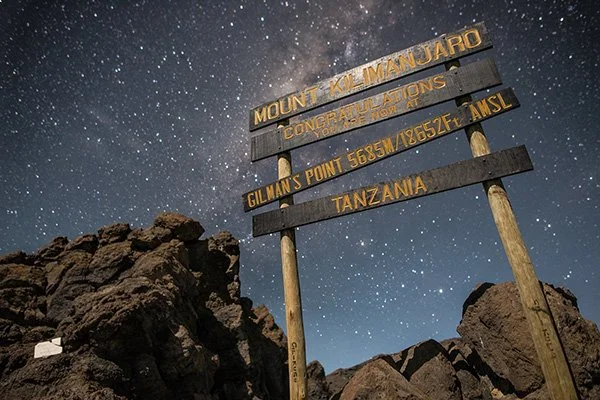
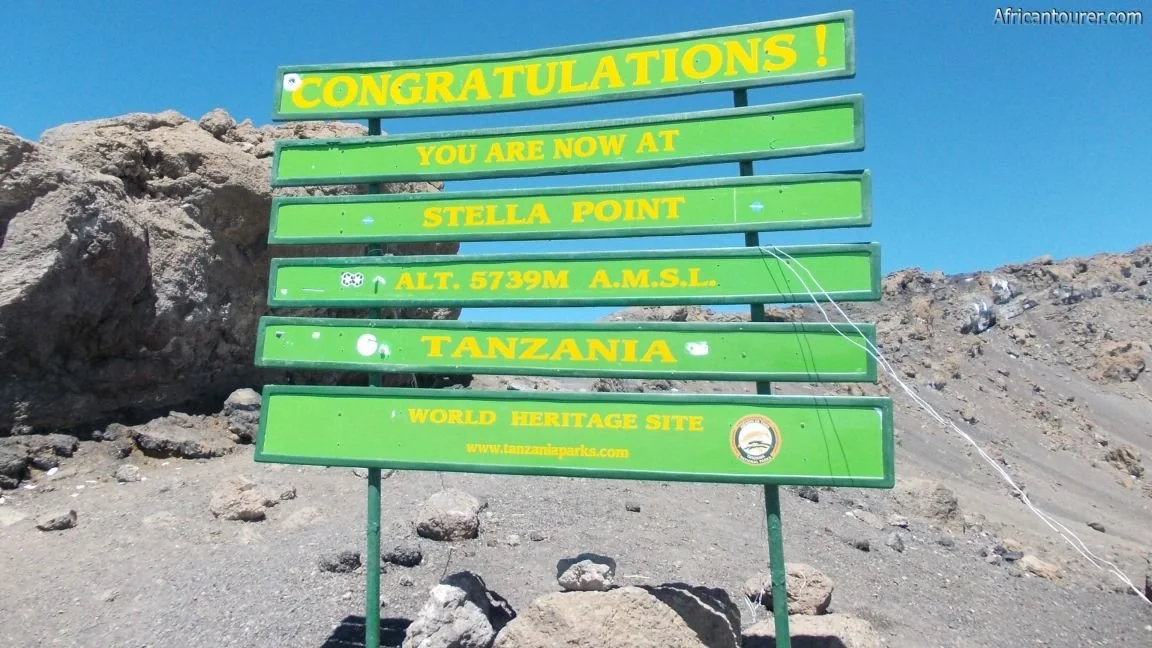
Stella Point - 5,656
The next top is Stella Point, roughly halfway between Gilman’s Point and the final stop, Uhuru Peak.
At each stop we rest for a short period, before continuing.
Uhuru Peak - The Summit - 5,895m
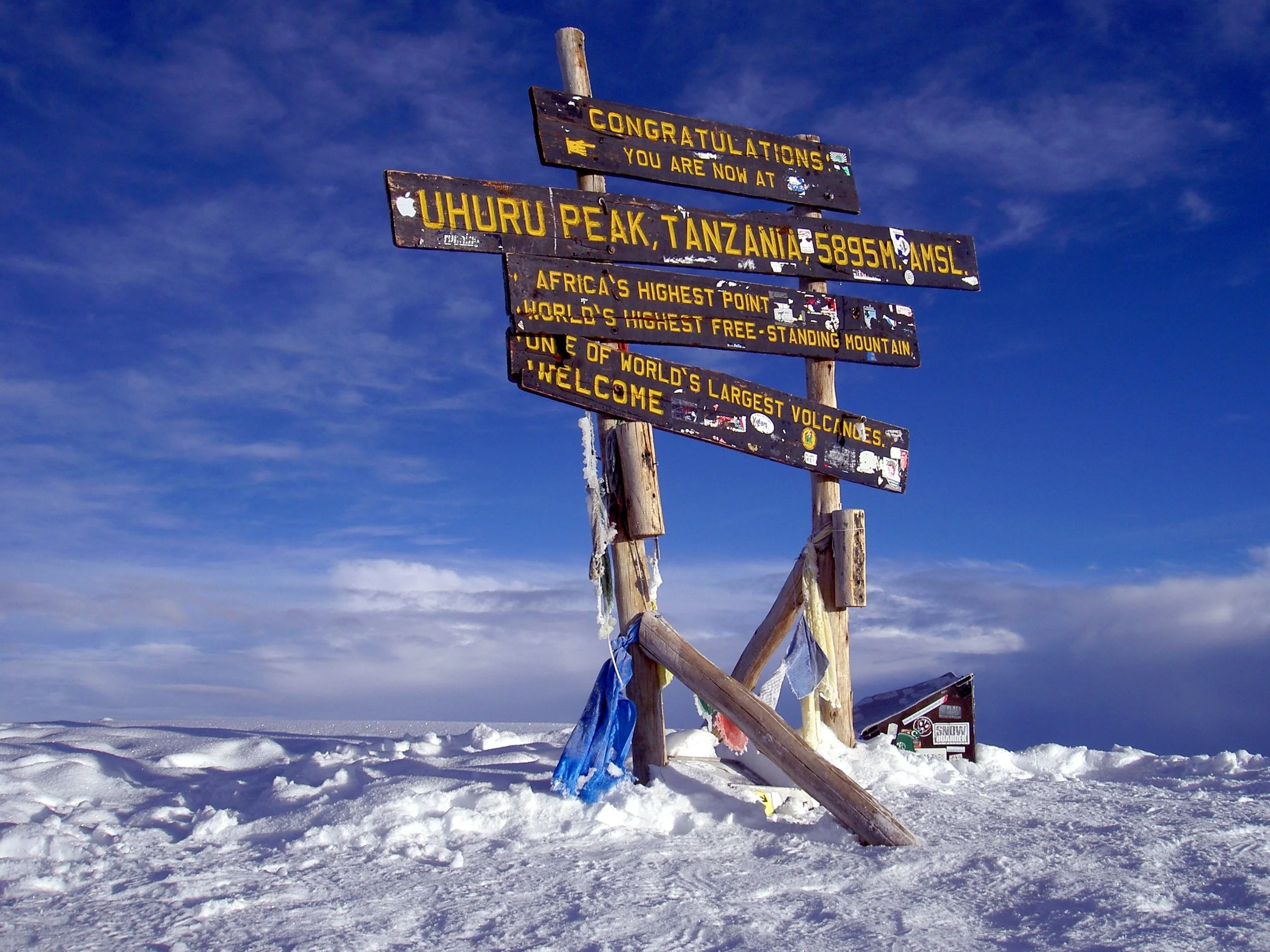
We finally arrive at Uhuru Peak, the highest point of Kilimanjaro, and the highest peak in Africa!
The temperature here ranges from -25 to -7, although the sun usually shines bright!
The Roof of Africa
"Uhuru" means freedom in Swahili — the peak was named to mark Tanganyika's independence in 1961. A simple wooden sign marks the highest point in Africa, and there's a logbook kept in a small wooden box where summiteers add their names. It's the classic spot for that hard-earned photo. All around you the summit is ringed by ancient glaciers, with Kibo's crater and ash pit just beyond — an unforgettable, almost otherworldly place to stand.
Because of the extreme altitude and cold, we don't linger long at the very top — just long enough to take it all in, get your photos and celebrate, before we begin the descent towards thicker, warmer air.
The journey back down
Coming down is much quicker than going up. From the summit we descend back to base camp for a rest and something to eat, then carry on down to a lower camp for the night. Walking poles really earn their keep here, taking the strain off your knees on the loose, sandy slopes. After the long effort of summit night, dropping into richer air feels wonderful — and you'll sleep soundly, knowing you've stood on the Roof of Africa.
An achievement of a lifetime
Reaching Uhuru Peak is a genuine achievement that stays with you for life. Many climbers describe standing on the summit, watching the sun rise over the plains far below, as one of the most moving moments they've ever experienced — and exactly why they came. It's the reward for every step of preparation, patience and "pole pole" determination along the way.