Marangu Route
The Marangu Route — widely known as the "Coca-Cola Route" — is the oldest and most established path up Kilimanjaro. It's the only route where you sleep in huts rather than tents, which makes it a comfortable choice in colder or wetter months and a favourite with climbers who'd rather have a bunk and a dining hut than a campsite.
Marangu has a reputation as the easiest way up the mountain thanks to its steady, gradual gradient and well-graded path. There is a trade-off, though: because you ascend and descend along the same trail, it offers less scenic variety and a weaker "climb high, sleep low" acclimatisation profile. On the shortest itineraries this gives it the lowest summit success rate of all the routes, so we strongly recommend adding an extra acclimatisation day at Horombo.
At a glance
- Duration: 6 days minimum (a 5-day version is available by special request only)
- Distance: approximately 70 km return
- Start: Marangu Gate, south-east of the mountain
- Accommodation: shared mountain huts (the only hut route on Kilimanjaro)
- Difficulty: the gentlest gradient, with no technical climbing required
- Summit: Uhuru Peak, 5,895 m
Huts, not tents
You'll overnight in the Mandara, Horombo and Kibo huts — simple dormitory-style accommodation with shared dining huts. For many climbers the comfort of a roof, a bunk and a communal meal after a long day is a real draw, particularly outside the driest months.
Scenery and terrain
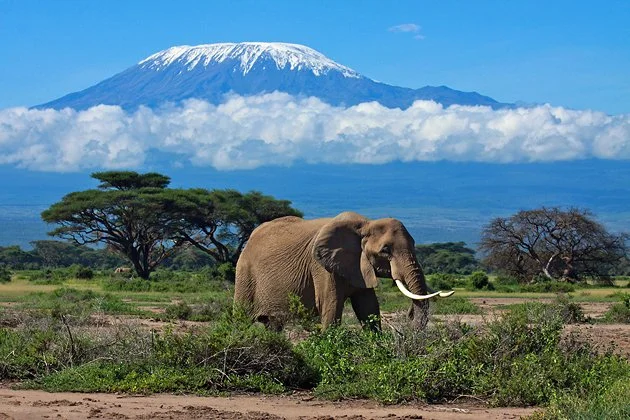
The route climbs through montane rainforest, into open moorland, across high alpine heath and desert, and finally up the stone scree to the ice-capped summit.
Suggested 6-day itinerary
Day 1 – Marangu Gate to Mandara Hut
From Marangu Gate the trail winds gently up through beautiful montane rainforest alive with birdsong — rain is likely here, so pack a jacket. You'll spend the night in the A-framed huts at Mandara.
- Trekking distance: approximately 8 km
- Trek time: 3–4 hours
- Environment: Montane rainforest
- Elevation: 1,800 m to 2,700 m
Day 2 – Mandara Hut to Horombo Hut
The forest opens into rolling moorland dotted with giant lobelia and groundsel, with grand views of Mawenzi and Kibo ahead. Horombo is a busy, sociable hut shared by climbers heading both up and down.
- Trekking distance: approximately 12 km
- Trek time: 5–6 hours
- Environment: Moorland
- Elevation: 2,700 m to 3,720 m
Day 3 – Acclimatisation day at Horombo
A rest-and-acclimatise day built around a short "climb high, sleep low" hike — typically towards the Zebra Rocks or the saddle below Mawenzi (around 4,000 m) — before returning to sleep at Horombo. This extra day markedly improves your summit chances.
- Highest point: approximately 4,000 m (acclimatisation hike)
- Trekking distance: approximately 5 km
- Trek time: 2–4 hours
- Environment: Alpine moorland
- Elevation: sleep at 3,720 m
Day 4 – Horombo Hut to Kibo Hut
Crossing the stark, lunar "saddle" between Mawenzi and Kibo, the vegetation disappears entirely. Kibo Hut sits at the foot of the summit cone, where you'll rest early ahead of a midnight start.
- Trekking distance: approximately 10 km
- Trek time: 5–6 hours
- Environment: Alpine desert
- Elevation: 3,720 m to 4,700 m
Day 5 – Kibo Hut to Uhuru Peak, descent to Horombo Hut
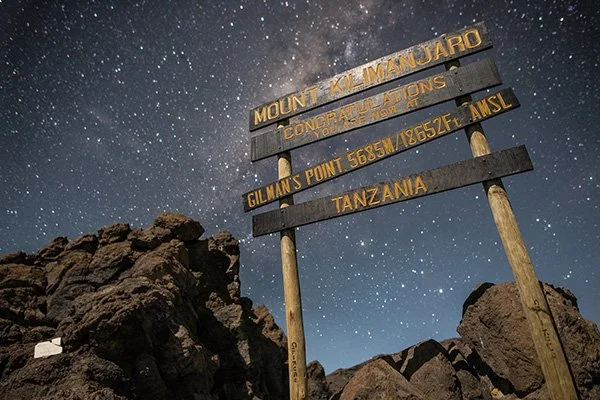
Summit night. Setting off around midnight, you'll climb switchbacks of scree to Gilman's Point (5,681 m) on the crater rim, then continue around to Uhuru Peak (5,895 m) for sunrise. After celebrating you'll descend all the way back to Horombo.
- Highest point: 5,895 m (Uhuru Peak)
- Trekking distance: approximately 16–22 km
- Trek time: 10–13 hours
- Environment: Volcanic scree, glaciers and ice
- Elevation: 4,700 m to 5,895 m, then down to 3,720 m
Day 6 – Horombo Hut to Marangu Gate
A long, steady descent retraces the moorland and rainforest back to Marangu Gate, where your summit certificates are presented before the drive back to Moshi.
- Trekking distance: approximately 18 km
- Trek time: 5–6 hours
- Environment: Moorland and rainforest
- Elevation: 3,720 m to 1,980 m
The 5-day version removes the Horombo acclimatisation day. We don't recommend it — the extra day makes a big difference to how you feel on summit night and to your chance of reaching the top.
Who is Marangu best for?
Marangu suits climbers who prefer a bed to a tent, who are climbing in the wetter shoulder seasons, or who would rather avoid the Barranco Wall found on routes like Machame and Lemosho. Take the extra acclimatisation day and it's a thoroughly rewarding way to the summit.
You'll often hear Marangu called the "Coca-Cola Route" — a nickname that nods to its standing as the gentlest and most well-trodden way up the mountain, and to the days when soft drinks were sold at the huts along the trail. It sits in cheerful contrast to the steeper, more demanding Machame trail, which earned the nickname the "Whiskey Route".
Pros and cons
Pros
- The gentlest, most gradual gradient of any route up the mountain.
- The only route with proper huts — a roof, a bunk and a dining hut.
- A good choice in the colder or wetter months.
- Avoids the Barranco Wall found on routes like Machame and Lemosho.
- The shortest itinerary on the mountain.
Cons
- You ascend and descend on the same trail, so there's less scenic variety.
- A weaker "climb high, sleep low" acclimatisation profile.
- The lowest success rate on the shortest itinerary — we strongly recommend taking the extra Horombo acclimatisation day.
- The shared huts can be busy and noisy.