Weather
What’s the weather like on Kilimanjaro?
The short answer is that the temperatures on Mount Kilimanjaro range from hot to bitter cold. The journey from the gate to the peak is like traveling from the equator to Antarctica in a matter of days. This is because the routes to the Uhuru peak cross different ecological zones. Mount Kilimanjaro has five major ecological zones, each approximately 3,280 feet (1,000 m) in altitude. Each zone is subject to a corresponding decrease in rainfall, temperature and life as the altitude increases.
As an example of average local seasons, for the nearby city of Moshi, January and February are the warmest months, April and May are the wettest months, June and July are the coolest months, and August and September are the driest months. These generalities about the weather in Moshi hold true for Mount Kilimanjaro as well.
What’s the best time of the year to climb Kilimanjaro?
There's no perfect time to climb, as each season has it's own pros and cons - we prefer January to March to due to less climbers, but it's an amazing adventure and fully accessible all year round.
January to March - Dry & Quiet - typically less climbers on the mountain, but fantastic weather.
Apr to May - Rainy Season - often raining at higher altitudes, but an amazing experience and a very quiet mountain!
June to November - Dry & Active - this is the peak time for climbing, the best weather, and the best views
November to December - Brief Rainy Season - Our favourite time as it’s very quiet on the mountain, but also a little rain from time to time.
Weather Zones
Due to its proximity to the equator, Mount Kilimanjaro doesn’t experience wide temperature ranges from season to season. Instead, the temperatures are determined more so by the altitude and time of day. At the beginning of the climb, at the base of the mountain, the average temperature is around 70 to 80 degrees Fahrenheit (21 to 27 degrees Celsius). From there, the temperatures will decrease as you move through Mount Kilimanjaro’s ecological zones.
At the summit, Uhuru Point, the night time temperatures can range between 20 and -20 degrees Fahrenheit (-7 to -29 degrees Celsius). Due to Mount Kilimanjaro’s great height, the mountain creates its own weather. It is extremely variable and impossible to predict. Therefore, regardless of when you climb, you should always be prepared for wet days and cold nights.
Below are the five zones from the lowest to the highest altitude along with the average annual precipitation and zone characteristics.
One of the most remarkable things about climbing Kilimanjaro is that you pass through five distinct climate (or ecological) zones on the way up — each roughly 1,000 m of altitude, and each with its own temperature, rainfall, plant life and wildlife. As you climb, the rainfall, the warmth and the amount of life all steadily fall away. Trekkers often describe it as walking from the equator to the Arctic in the space of a few days.
1. Cultivation Zone (Bushland)
Altitude: 800–1,800 m (2,600–6,000 ft) · Rainfall: 500–1,800 mm · Temperature: roughly 21–30°C by day, mild nights
Every climb begins here, on Kilimanjaro's lower slopes. Rich volcanic soil and reliable rain make this a green patchwork of small farms, coffee and banana plantations, grassland and busy villages — the original lowland scrub and forest have largely given way to cultivation. It's warm, lush and gentle: an easy introduction before the trail steepens and the air begins to cool.
2. Rainforest (Montane Forest)
Altitude: 1,800–2,800 m (6,000–9,200 ft) · Rainfall: up to ~2,000 mm (the wettest zone) · Temperature: ~12–25°C by day, cooler on clear nights
A lush belt of tropical montane forest wraps right around the mountain, draped in mosses, lichens, ferns and orchids beneath a towering, often misty canopy. This is the richest zone for wildlife — black-and-white colobus and blue monkeys, baboons, small antelope, bushpigs and a wonderful variety of birds, though larger game is now rare. Expect humidity, the odd shower and slippery underfoot conditions, and the real magic of trekking up through the clouds.
3. Heath & Moorland
Altitude: 2,800–4,000 m (9,200–13,200 ft) · Rainfall: ~530–1,300 mm · Temperature: ~10–20°C by day, often below freezing at night
Above the forest the air clears and the landscape opens into semi-alpine heath and moorland — giant heathers, tussock grasses and seasonal wildflowers under big skies. This is the home of Kilimanjaro's famous giant groundsels (Senecios) and giant lobelias: strange, otherworldly plants that have evolved their own "fur" and water-storing tricks to survive the cold nights. Sweeping views open up, and most climbers feel the first real effects of altitude here.
4. Alpine Desert
Altitude: 4,000–5,000 m (13,200–16,500 ft) · Rainfall: ~250 mm (very dry) · Temperature: a huge daily swing — warm in direct sun, hard frost and sub-freezing nights
A stark, high-altitude desert of volcanic rock, scree and dust, with little water and only the hardiest mosses, lichens and "everlasting" flowers clinging on. The air is thin and the daily temperature range is enormous: fierce sun and glare by day, bitterly cold once it sets. This is the zone where steady pacing, hydration and good acclimatisation matter most as you prepare for the summit.
5. Arctic (Summit) Zone
Altitude: 5,000–5,895 m (16,500–19,341 ft) · Rainfall: <100 mm, mostly as snow · Temperature: around -5 to 5°C by day, -10 to -25°C at night
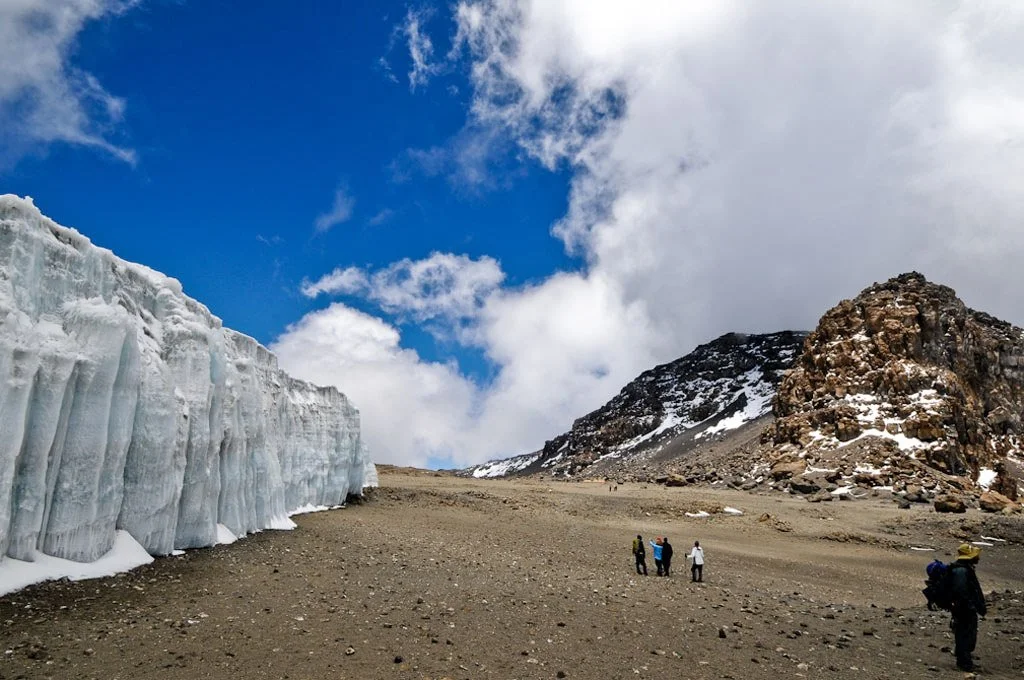
The summit zone is a world of ice, rock and ancient glaciers, with roughly half the oxygen available at sea level. Almost nothing lives here but the oldest lichens. Nights are brutally cold and the unfiltered, high-altitude sun is intense, so thermal layers, sun protection and careful hydration are essential. This is the final push to Uhuru Peak (5,895 m) — the Roof of Africa, and the highest point on the continent.